Gastric sleeve surgery (sleeve gastrectomy) is a bariatric surgery method in which around 80% of the stomach is removed and what remains is narrowed into a tube. The short answer is this: eligibility rests not on the number on the scales but on the BMI value that relates weight to height, and current guidance sets that threshold at BMI 35 — about 101 kg for someone 1.70 m tall. This article explains the eligibility thresholds, what the BMI figures mean in kilograms, the age question, the conditions that can rule surgery out, and how the assessment process works.
Why is eligibility based on BMI rather than weight?
Weight by itself does not show whether a person is suitable for surgery, because the same weight means something entirely different at different heights. Ninety-five kilograms corresponds to class II obesity (BMI 37.1) in someone 1.60 m tall, while in someone 1.90 m tall it sits at the edge of the overweight range.
International guidelines therefore work from body mass index. BMI is calculated by dividing a person's weight in kilograms by the square of their height in metres:
BMI = Weight (kg) ÷ Height² (m)
Example: for a person weighing 105 kg and standing 1.70 m tall, BMI = 105 ÷ (1.70 × 1.70) = 36.3.
To find your own value, you can use our BMI calculator. The World Health Organization defines a BMI of 30 and above as obesity [2].
General eligibility criteria for gastric sleeve surgery
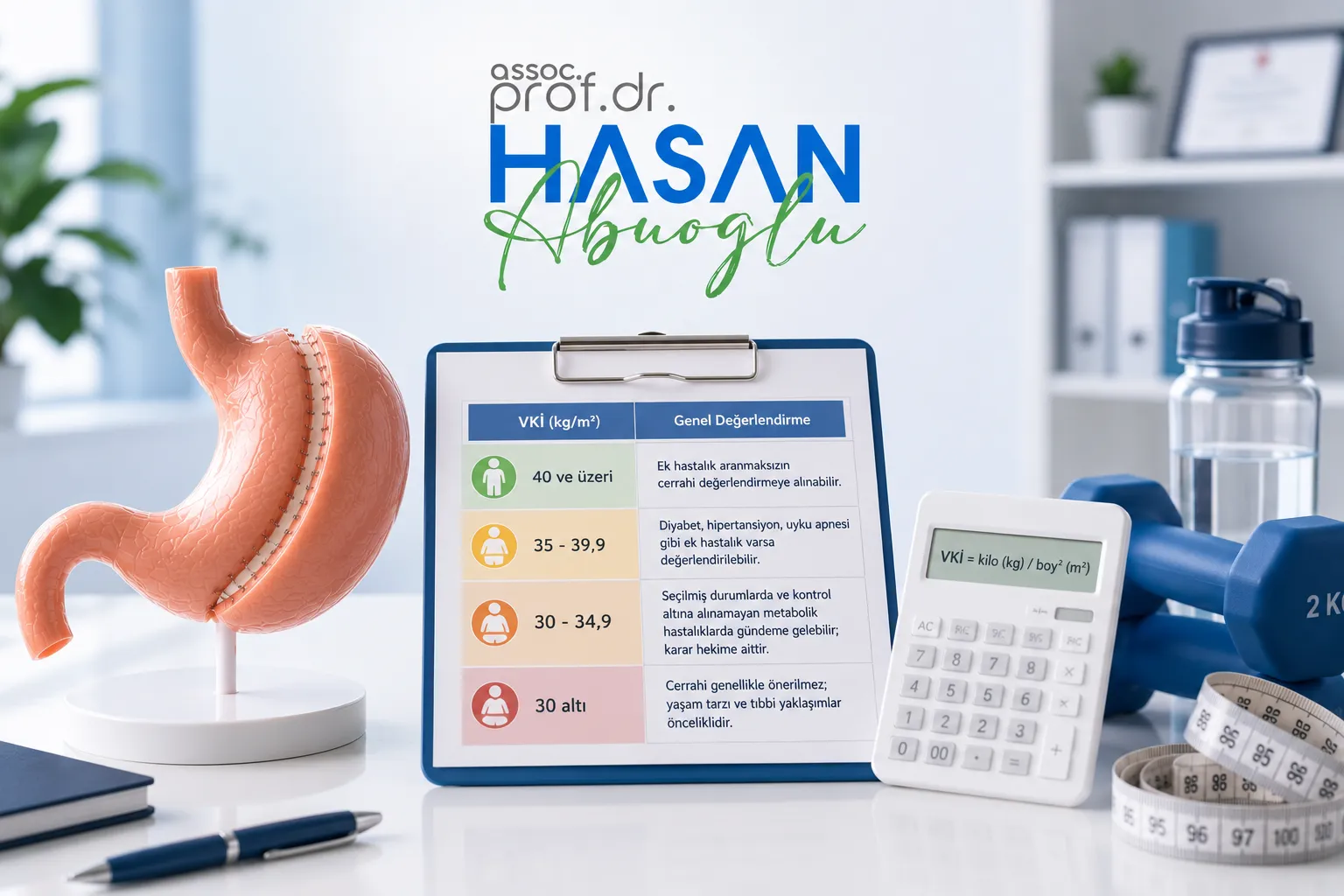
| BMI value | Classification | Current guideline framework [1] |
|---|---|---|
| 40 and above | Class III obesity | Assessment for surgery is recommended. |
| 35 – 39.9 | Class II obesity | Assessment for surgery is recommended whether or not an accompanying condition is present. |
| 30 – 34.9 | Class I obesity | Assessment for surgery is recommended when metabolic disease is present. |
| Below 30 | Overweight / normal | Surgery is not recommended for this range; nutrition and medical approaches take priority. |
The BMI thresholds were updated in 2022, and this detail is still circulating in its old form in a great many sources. Under the 1991 NIH consensus, the BMI 35–39.9 band was assessed only when an accompanying condition was present; the 2022 joint statement from ASMBS and IFSO [1] removed that requirement and also brought the BMI 30–34.9 band into scope where metabolic disease is present.
Practice can vary between institutions, and documenting accompanying conditions strengthens the case in any event. Final eligibility is determined by the person's medical history, the test results and a physician's examination.
What weights do the BMI thresholds correspond to?
The question patients ask most often is "at what weight would I qualify?" The table below shows the approximate weight equivalents of the BMI 35 and BMI 40 thresholds for common heights.
| Height | BMI 35 threshold | BMI 40 threshold |
|---|---|---|
| 1.55 m | ~84 kg | ~96 kg |
| 1.60 m | ~90 kg | ~102 kg |
| 1.65 m | ~95 kg | ~109 kg |
| 1.70 m | ~101 kg | ~116 kg |
| 1.75 m | ~107 kg | ~123 kg |
| 1.80 m | ~113 kg | ~130 kg |
| 1.85 m | ~120 kg | ~137 kg |
The values in the threshold table are meant only to give a rough orientation. Two people with the same BMI value may still differ in eligibility, because of their accompanying conditions and their general state of health.
Is surgery possible at 80, 90 or 100 kg?
There is no single answer to "I weigh 80 kg, can I have surgery?"; no assessment can be made without knowing the height.
- 80 kg — BMI 31.3 at a height of 1.60 m (class I obesity), BMI 26.1 at 1.75 m (overweight). In the first case surgery may come up if metabolic disease is present; in the second it is not recommended.
- 90 kg — BMI 35.2 at 1.60 m, that is, just above the threshold. At 1.80 m it stays below it, at BMI 27.8.
- 100 kg — BMI 39.1 at 1.60 m, 34.6 at 1.70 m, 29.2 at 1.85 m. As you can see, the same weight can fall into three different classes.
Asking "what is my BMI, and do I have an accompanying condition?" is therefore a sounder starting point than asking "how many kilograms?"
Can I have surgery if my BMI is 30?
The BMI 30–34.9 band is not one in which surgery is routinely recommended. Current guidance [1] does, however, recommend that surgery be assessed in people in this band who have a metabolic disease; the example met most often is type 2 diabetes that cannot be brought under control despite drug treatment. The approach that comes up in such cases is covered under the heading of metabolic surgery.
When a decision is made in the BMI 30–34.9 band, the following are weighed together: how long the metabolic disease has been present and how well controlled it is, the response to the medicines being used, other accompanying disorders, and the person's capacity to keep to the post-operative regimen. The decision is individual in every case.
I have diabetes or high blood pressure — am I eligible?
Accompanying conditions are not factors that reduce eligibility; more often they increase the benefit expected from surgery. Although current guidance requires no accompanying condition at BMI 35 and above, the presence of metabolic disease is the very criterion that makes assessment possible in the BMI 30–34.9 band.
The accompanying conditions most often taken into account in the assessment are:
- Type 2 diabetes — blood sugar control and the need for medication
- Hypertension — blood pressure control and the number of medicines used
- Obstructive sleep apnoea — sleep study findings and use of a device
- Fatty liver — imaging and liver function tests
- Joint problems — particularly how much load the knees and lower back can carry
- Polycystic ovary syndrome and the reproductive health problems that go with it
In a 10-year randomised trial conducted in patients with type 2 diabetes and a BMI of 35 or above (the methods used were gastric bypass and biliopancreatic diversion), diabetes remission lasted throughout the 10 years in 37.5% of the patients in the surgical arm, while in the medical therapy arm that figure remained at 5.5%; on the other hand, blood sugar rose again during follow-up in 58.8% of the patients who had reached remission at year 2 [3]. These data were obtained for the two methods named, not for gastric sleeve, and do not amount to a promise of an individual result.
Accompanying conditions being uncontrolled is a separate matter: severe heart failure or advanced lung disease that has not been brought under control raises the risk of the operation and may delay or prevent the process.
Is there an age limit? Under 18 and over 65
Bariatric surgery is assessed predominantly in adult patients. Rather than a fixed upper age limit, the person's general state of health and the benefit–risk balance are what decide the matter [4].
- Under 18 — In adolescents, surgery comes up only in highly selected cases and through assessment by a multidisciplinary team that includes paediatric endocrinology. Growth and development are watched over as well.
- 18 to 65 — The band in which assessment is most often made.
- Over 65 — Age by itself is not a barrier. Cardiac, pulmonary and renal function, along with suitability for anaesthesia, are examined in more detail; whether the expected benefit outweighs the risk is weighed up.
Is BMI on its own a sufficient measure?
BMI is a practical and widely used measure, but it is not flawless: it does not distinguish muscle mass from fat mass. A very muscular person may have a high BMI while their body fat percentage is low. For this reason the assessment looks at the following alongside BMI:
- Waist circumference — fat around the abdomen is treated as a separate indicator of metabolic risk.
- Body composition — the ratio of fat mass to muscle mass.
- Metabolic markers — fasting blood glucose, HbA1c, blood lipids, liver enzymes.
Waist circumference, body composition and metabolic markers do not take the place of BMI; they complement it and allow the decision to be made more accurately.
Do I need to lose weight before surgery?
In some cases a certain amount of weight loss may be asked for before surgery. The purpose of this is not cosmetic but surgical safety: a smaller liver makes reaching the stomach easier during the operation and makes the procedure technically safer.
During the preparation period before surgery, the following are usually planned: regulating energy intake, maintaining protein intake, increasing fluid consumption and correcting any vitamin deficiencies. How much weight is to be lost, and over how long, varies from person to person; the physician and the dietitian decide this together.
Who may not be suitable?
The situations below may rule out gastric sleeve surgery, may call for the method to be changed, or may lead to the process being postponed:
- Severe heart, lung or kidney disease that has not been brought under control
- Barrett's oesophagus — cell change at the lower end of the oesophagus; a condition generally judged unsuitable for a gastric sleeve
- Severe or uncontrollable reflux and a large hiatal hernia — because a gastric sleeve can increase reflux, another method such as gastric bypass is mostly preferred in these people
- Advanced liver cirrhosis and portal hypertension
- Active substance or alcohol use disorder
- Untreated eating disorders (bulimia nervosa, binge eating disorder) and untreated serious psychiatric conditions
- An expectation that the nutrition and follow-up regimen after surgery cannot be adhered to
- Pregnancy, or a plan to become pregnant in the near future
- Bleeding disorders that make surgery risky
Some of the items above are temporary, and the process can be reassessed once they have been treated; others may mean that the method is changed or that surgery is set aside. Only a physician's examination and the test results can tell the two apart. You will find the full set of eligibility criteria in our article on who qualifies for sleeve gastrectomy, and the possible risks of the procedure in what are the risks of stomach surgery.
How does the assessment process work?
- Physician's examination — BMI measurement, weight history and assessment of accompanying conditions.
- Laboratory tests — full blood count, biochemistry, thyroid and vitamin levels.
- Endoscopy — examination of the stomach and the oesophagus. This step is decisive, because a finding of reflux, a large hiatal hernia or Barrett's oesophagus may require the planned method to be changed.
- Imaging and consultations — cardiology, respiratory medicine, endocrinology and psychiatry opinions where needed.
- Nutritional assessment — planning the eating pattern before and after surgery.
- Giving up smoking and alcohol — smoking is to be stopped a certain period before the operation, because it raises the risk of staple line leak, ulcers and wound healing problems.
- Decision and planning — all the findings are weighed together and an individual decision is reached.
The aim of the assessment process is not only to answer the question "suitable or not", but to complete the preparation needed for surgery to be carried out safely. We described how much time the process takes on the day of surgery in how long does gastric sleeve surgery take.
What can I do if I am not suitable?
The process does not end when surgery is found unsuitable. Restructuring the eating pattern, increasing physical activity step by step, medical treatment of the accompanying conditions, drug treatment directed at obesity where a physician judges it appropriate, and endoscopic methods where needed may all come into play. Endoscopic applications such as the gastric balloon are among the options that can be assessed in some people below the surgical threshold.
The suitability, the dose and the duration of drug treatment directed at obesity are individual matters; it should not be started without a physician's assessment and prescription.
Find Out Your BMI
Enter your height and weight to see straight away which range you fall into.
BMI CalculatorReferences
- [1] Eisenberg D, Shikora SA, Aarts E, et al. 2022 American Society of Metabolic and Bariatric Surgery (ASMBS) and International Federation for the Surgery of Obesity and Metabolic Disorders (IFSO) Indications for Metabolic and Bariatric Surgery. Obes Surg. 2023;33(1):3-14 — PubMed
- [2] World Health Organization — Obesity and Overweight Fact Sheet — WHO
- [3] Mingrone G, Panunzi S, De Gaetano A, et al. Metabolic surgery versus conventional medical therapy in patients with type 2 diabetes: 10-year follow-up of an open-label, single-centre, randomised controlled trial. Lancet. 2021;397(10271):293-304 — PubMed
- [4] Arterburn DE, Telem DA, Kushner RF, Courcoulas AP. Benefits and Risks of Bariatric Surgery in Adults: A Review. JAMA. 2020;324(9):879-887 — PubMed